

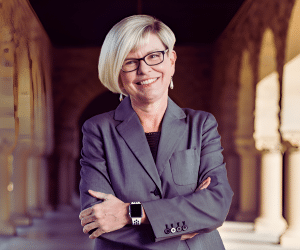
Shelley J. Correll is the Michelle Mercer and Bruce Golden Family Professor of Women’s Leadership and professor of sociology and (by courtesy) organizational behavior at Stanford University. She is a force of discipline-shifting scholarship and a leader in transformational change. Throughout her career, Correll has shown us how sociologists can get into the trenches with the organizations and institutions they study to make real change. She teaches us how to speak about our sociological truths to hegemonic institutions. She is an inspiration to all who seek not only to understand the social world more deeply, but to do work that actively makes it better.
A Reluctant Convert
One might say that Correll backed into sociology, not because her initial encounters with it did not fascinate her, but because it never occurred to her that someone could really make a living at it. After graduating from Texas A&M in 1989 with a BS in chemistry, Correll worked in industry for a stint. This experience alerted her to troubling gender dynamics in STEM and inspired her to change course. She decided to try teaching high school math and science. During her teacher training, she took some courses at the University of Houston. There, she encountered eminent sociologist of gender, Janet Chafetz, who prophesied to Cecilia Ridgeway that “[Shelley] should have a tremendous career.” Chafetz convinced a reluctant Correll to apply to PhD programs in sociology.
When Correll visited the sociology department at Stanford University after being admitted to the doctoral program, Ridgeway worked hard to recruit her. It wasn’t easy. There was stiff competition from Paula England, who was recruiting Correll to the University of Arizona. Although she remained skeptical that a career in sociology would work out, Correll was deeply interested in gender as a social process, especially in organizations and work, and captivated by the study of society more broadly. In true “Shelley fashion,” she told Ridgeway she would give Stanford sociology a try if she could do it on her terms. Those terms were that she would be allowed to design her own studies and collect her own data from her first term in graduate school. That is exactly what she did. Correll received a master’s degree in 1996 and her doctorate from Stanford in 2001, publishing one of her dissertation papers that same year in the American Journal of Sociology (AJS). She was a star from the beginning.
Building A Scholarly Legacy
Correll began her faculty career at the University of Wisconsin-Madison in 2001. Cornell University recruited her two years later, promoting her to associate professor in 2005. The “steal Shelley” game continued through 2008, when Stanford University hired her in turn. She was promoted to professor of sociology in 2012 and was appointed a courtesy professor of organizational behavior at the Stanford Graduate School of Business in 2013.
Correll’s rapid rise to prominence in sociology was fueled by two sets of scholarly contributions early in her career, both of which continue to have wide influence in the discipline. Right out of the gate, Correll made a major contribution to our understanding of how the gender segregation of jobs—the major determinant of women’s wage and authority disadvantages—persists. The received wisdom at the time was that gender segregation exists not only because of “demand side” employer discrimination but also “supply side preferences” on the part of women.
Correll refused to accept that women simply “prefer” to work in lower-paid occupations. She reasoned that it is not just employers that are biased by widely held cultural status beliefs that favor men and cast women as diffusely less competent — especially at the things that “count,” such as math, technology, and leadership—but that women themselves are held back by these gender status beliefs, too. Such beliefs inflict self-doubt and bias downward women’s self-assessment of their abilities. In a 2001 AJS article, Correll showed that women with the same math scores and grades assess their math abilities as lower than men do, which affects their likelihood of persisting in math and science. Then, in a 2004 ASR article, Correll used controlled experiments to demonstrate the causal effect of the perceived gender typing of a task on women’s assessment of their own ability at that task and their willingness to pursue the task further. Together, these studies changed the sociological understanding of how gender segregation in the labor market endures.
She then took on another question at the heart of workforce gender inequality: bias against working mothers. Many scholars at the time argued that the wage penalty mothers face stems from their being less productive than non-mothers. Correll said, “Really?” and questioned that maybe it is that widely held cultural beliefs about gender bias lead employers and others to assume that mothers are less committed and therefore less competent and productive workers. She conducted a brilliant pair of studies illustrating how this motherhood bias creates wage penalties. In one experiment, she matched resumes of women across motherhood status and across race and had respondents evaluate them for hiring, promotion potential, and salary. Evaluators demonstrated systematic bias against mothers across race and Black women across motherhood status. Then, in an audit study, these same matched resumes were submitted to real, advertised jobs. Resumes of mothers across racial categories received significantly fewer callbacks than those of fathers and non-mothers. The 2007 AJS article reporting these studies has been cited more than 4,000 times and has changed the dialogue about motherhood penalties in the workplace in sociology and in public debate more broadly. As Harvard University Sociology Professor David Pedulla said, “Shelley’s scholarship has transformed how we understand the mechanisms and processes that give rise to gender inequality in contemporary society.”
After conducting this groundbreaking research revealing systematic biases against women in employment, Correll turned her attention to ways to minimize racialized gender biases in workplace contexts, with particular attention to biases about perceived competence and authority. Indeed, the goals for her scholarship have always been two-fold: to advance scholarly understanding of gender inequities and the social mechanisms that produce them; and to identify concrete, research-grounded practices to address them in organizations and institutions. As Dr. Marianne Cooper, senior research scholar, VMware Lab, said, “Shelley’s work combines pioneering research on gender bias with models for organization change, making her one of the rare scholars focused not only on how inequality persists, but on how it can be dismantled.”
Harnessing Sociology for Transformational Change
Correll has been invested in transformational change since the start of her career. Sarah Soule, dean of the Stanford School of Business, lauds Correll as an “exceptional sociologist…committed to translating [research] into actionable insights that help organizations build healthier, more innovative cultures. Just as important, Shelley lives these principles every day …she is an extraordinary mentor and leader, who models the culture her research so powerfully advocates.” And Soule would know; she and Correll have been colleagues and friends since they were assistant professors together at Cornell.
In 2009, Correll became the director of the Michelle R. Clayman Institute for Gender Research at Stanford, an institute with the explicit aim of “putting research into action” to advance gender equality. She set an ambitious agenda for the institute from day one: cultivate an interdisciplinary cadre of scholars working to identify mechanisms of gender inequality; and build research, intervention, and outreach infrastructures to bring those insights to leaders and change agents who need them. Under Correll’s leadership, the institute worked with the biggest tech companies in Silicon Valley to change their practices from the inside out.
A signature initiative under Correll’s leadership at the institute was the “Redesigning/Redefining Work” summits—annual gatherings that brought work and organization scholars together with industry leaders to address concrete problems in innovative ways. She is not content with people just gathering and sharing ideas; her aim is always to foster the identification and sharing of tangible strategies to promote equity.
In 2014, Correll took the next step in her transformational leadership journey by founding the VMware Women’s Leadership Innovation Lab at Stanford. The lab’s goal is to advance research on the mechanisms that promote organizational gender inequality and design equity-promoting interventions that work in the real world. Dr. Sara Jordan Bloch, director of research and education at the VMware lab, has worked with Correll for nearly two decades: “[Shelley’s] unwavering philosophy has been that we should create our own organizations in the image of organizations we want to see in the world. She leverages her deep expertise in organizational behavior and the way everyday interactions, experiences, and structures shape people’s work experiences to create organizations that both support individuals and promote inclusive and equitable cultures. For Shelley, it’s not enough to just understand a problem.”
At the heart of the initiatives that Correll champions is a productive tension between what needs to be done to overturn racialized and classed systems of misogyny and sexism, and what can be done in the context of real-world organizations. For-profit organizations, in particular, face strong disincentives to make the tectonic shifts sociologists recognize as necessary for rapid social change. Correll sees critical opportunities in the vast middle ground between these tectonic shifts and no action at all.
In her 2016 Sociologists for Women in Society Feminist Lecture, published in 2017 in Gender & Society, Correll laid out her agenda for a “small wins” approach to organizational change. Her change model has two key elements: co-designing interventions with management and organizational leadership; and producing and empirically documenting small, measurable, positive outcomes. “For reasons we understand too well, progress toward gender equality has been slow, uneven, and often met with resistance,” Correll wrote. “However, our scholarly community is well-poised to intervene, empowering people who desire to be agents of positive change to better achieve their goals….If we, as academics, can find ways to collaborate with those organizational actors, then together we can jumpstart progress.”
Sarah Thébaud, professor of sociology at University of California-Santa Barbara, explained: “[Correll’s] work is transformative for the study of gender inequality because it provides an exemplary model for how we, as sociologists, can produce rigorous, theory-driven research that directly informs, and also is informed by, organizational leaders, policymakers, and others who are actually in a position to enact change.” Adina Sterling, associate professor at Columbia Business School, sums up what many of us feel about this integration of scholarship and change efforts: “I feel fortunate to have benefited from her intellectually and collaboratively. She has modeled for a generation of scholars how to do research that is real, felt, urgent.”
Mentoring the Next Generation of Scholars and Change Catalysts
In every academic position Correll has held, she has invested in the next generation of researchers and change agents. Her former students, postdocs, and colleagues expressed moving sentiments of gratitude. Aliya Hamid Rao, associate professor at the London School of Economics and Political Science, explained that Correll’s mentorship extended far beyond scholarship: “My postdoctoral fellowship with Shelley remains a highlight of my academic training. I met some of my favourite gender scholars because Shelley prioritises building an intellectual community that endures. I learned so much from Shelley: developing partnerships outside academia to ensure that academic research on gender remains broadly relevant; respecting people’s time; being realistic without devolving into cynicism.” Marbella Eboni Hill, associate professor at North Carolina State University, recalled: “I saw firsthand how deeply she embodies a commitment to maximizing sociology’s potential for public good, shaping both the field and the scholars she trains.”
Erin Cech was one of Shelley’s first postdocs at the Clayman Institute. In a talk at the 2019 summit celebrating Correll’s directorship, Cech said: “My postdoctoral fellowship with Shelley was the most intellectually exciting, intellectually nourishing year of my life. She created a vigorously interdisciplinary space that took the communication of gender scholarship to the public as seriously as it took the scholarship itself. It was electric. Shelley taught me how to be brave in sharing my work and maybe a little irreverent. She taught me how to teach others how to be agents of change.”
The ASA 2026 Annual Meeting Theme—Disrupting the Status Quo: Putting Sociologists to Work for a More Equitable Society
Reflecting many threads of Correll’s own career, the ASA 2026 Annual Meeting theme emphasizes the power of translational work. Correll asks us, “How can sociological expertise and knowledge be put to use in an era when it is needed most?” She answers thusly: “To have the greatest impact, we need a sociology that is focused on solutions, prioritizes externally engaged research, and is unapologetic in its ambition to create a more equitable world.”
Paula England, dean of social science at New York University-Abu Dhabi, and former ASA president, summed up the “multiple dimensions” that make Correll a phenomenal scholar and person: “She’s a rigorous researcher, a sensible presence at faculty meetings, a great mentor, a wonderful teacher, someone who really cares about changing the world, and someone who knows how to put it all down and just have fun with friends. What an inspired choice for ASA President!”