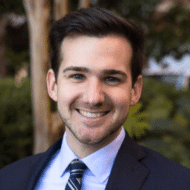
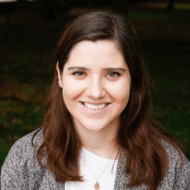
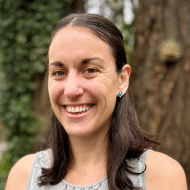
Harry Barbee is an assistant professor at the Johns Hopkins Bloomberg School of Public Health whose research focuses on LGBTQ+ health, aging, and health equity. Committed to public scholarship, Barbee serves on the Washington DC Board of Medicine and frequently translates research into accessible public discourse through op-eds and media engagements. Their work bridges sociological science and policy to advance equitable access to health care for historically underserved communities.
Anna Bokun, Population Research Center, University of Texas-Austin
Anna Bokun is a sociologist and demographer who received her PhD in sociology with a minor in demography from the University of Minnesota in 2024. Her research bridges family demography, aging, and employment, with a focus on economic vulnerability and social policy. Bokun uses statistical methods to analyze demographic changes across diverse data sources, including the U.S. Census, administrative records, and international datasets. She has contributed to multiple National Science Foundation-, National Institutes of Health-, and National Institute on Aging-funded projects and aims to inform public policy for more equitable outcomes across the life course.
Adrienne Brown, University of Arizona
Adrienne Brown is a postdoctoral scholar with the Udall Center for Studies in Public Policy, where she studies community engagement in environmental management. She holds a PhD in sociology from the University of New Hampshire with a specialization in community and environment. Her research interests include sense of place, knowledge production, and environmental justice, which she has applied to socio-environmental challenges, including wildfire resilience, forest management, and water governance.
Brittany Friedman, University of Southern California
Brittany Friedman is an assistant professor of sociology at the University of Southern California and co-founder of the Captive Money Lab. Recognized as an innovative thinker with respect to how people and institutions conceal harmful truths, her current work examines social control, racial violence, and the underside of government institutions, including prisons, courts, and treasuries. She is the author of Carceral Apartheid: How Lies and White Supremacists Run Our Prisons and has written for TIME Magazine, the Washington Post, and the Conversation. Friedman is also an affiliated scholar of the American Bar Foundation.
Shanelle Haile, McKinsey & Company
Shanelle Haile is a visiting fellow at the nonprofit think tank FCLTGlobal, seconded from her consulting role at McKinsey & Company, where she directs efforts to evaluate the impact of FCLT’s research on long-term capital allocation in global markets. She previously spent more than a decade advancing policy initiatives at the U.S. Department of Justice and the U.S. Agency for International Development. Haile holds a BA in psychology from Spelman College, an MEd in community development from Vanderbilt University, and an MA and PhD in sociology from Brown University.
Charis E. Kubrin, University of California, Irvine
Charis E. Kubrin is a professor of criminology, law and society, and (by courtesy) sociology at the University of California-Irvine. Her research examines the immigration-crime nexus and the impact of immigration-related policy on immigrants, immigrant families, and immigrant communities. Her National Science Foundation- and National Institute of Justice-funded research has resulted in numerous publications, including co-authored books Immigration and Crime: Taking Stock and Punishing Immigrants: Policy, Politics and Injustice. Kubrin has received multiple national awards from the American Society of Criminology and the Western Society of Criminology and was named a Fellow of the American Society of Criminology in 2019.
Emily Rauscher, Brown University
Emily Rauscher is a professor in the sociology department at Brown University. Her research focuses on inequality and education, particularly examining school spending to understand when and how investments can effectively improve child well-being and increase equality. Rauscher’s work demonstrates how returns on school investments extend beyond individual benefits to advance broader social good for groups and societies.
Lacee A. Satcher, Boston College
Lacee Satcher is an assistant professor of sociology and environmental studies at Boston College. As an urban environmental sociologist, she examines connections among racism, the environment, and health, focusing on how systems of oppression organize individuals across space and place to shape their relationships with built and natural environments. Her current research projects include examining climate change engagement among older Black Americans in the South and Northeast, as well as investigating intraracial differences in place attachment and perceptions of environmental inequality among Black residents of public housing in South Boston.
Yolanda M. Wiggins, San José State University
Yolanda Wiggins is an associate professor of sociology at San José State University (SJSU). Her research explores topics including race, family, higher education, STEM equity, and the social implications of artificial intelligence. She has published in high-impact sociology journals and public-facing outlets, including the Los Angeles Times, San Francisco Chronicle, Education Week, and Ms. Magazine. Wiggins is co-founder of the SJSU Tech Academy, an equity-focused STEM initiative, and holds a PhD in sociology from the University of Massachusetts-Amherst.
Our website uses cookies to improve your browsing experience, to increase the speed and security for the site, to provide analytics about our site and visitors, and for marketing. By proceeding to the site, you are expressing your consent to the use of cookies. To find out more about how we use cookies, see our Privacy Policy