

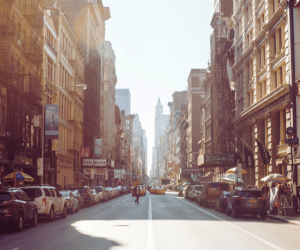
As a sociologist of aging and urban communities, I look at cities much differently than I did as a kid growing up in 1980s New York City. I was born five years after President Gerald Ford denied a federal bailout to the near-bankrupt city, prompting that infamous New York Daily News headline: “Ford to City: Drop Dead.” I hated growing up in Manhattan’s then much grittier Chelsea neighborhood, longing for the placid suburban malls, backyards, and houses with stairs that I saw on TV. My parents reared us as if the apocalypse unfolded outside our apartment’s steel door. In 1990, the year I turned 10, New York City’s murder total peaked at 2,605 homicides.
Decades later, now in midlife myself, I’ve come to a greater appreciation of the city that shaped me and its possibilities for my growing older, especially as I reflect on my ethnographic research with older adults in New York City.
In many ways, metropolitan areas are ideal places to grow old because of their greater walkability, public transportation, social infrastructure, and robust social services. But significant challenges remain for older adults of myriad backgrounds who face growing precarity that compromises their ability to “age in place,” or stay in their homes and communities for as long as possible. At the mercy of forces they cannot hope to control, they face increasing housing instability and homelessness due to factors such as climate disaster, job and partner loss, rising housing costs, disability and chronic illness, diminished rental subsidies, inadequate retirement savings, and a fraying social safety net. In the United States, proposed Section 8 cuts and efforts to divert funds from permanent to transitional housing will only exacerbate harm to older adults, the fastest-growing segment of the homeless population.
My work has focused on the power of place and asks: What is place? What is home? How can we best leverage the resources we have to lead long, healthy lives amid the many challenges we face as we age? And how do we make a home—or many homes—in the world? In my book, At Home in the City: Growing Old in Urban America (University of California Press 2025), I take up these and other questions about how best to balance competing demands for autonomy and social connection. To understand elders’ experiences with aging in place, I spent five years with longtime New York City residents as they coped with health setbacks, depression, gentrification, financial struggles, the accumulated losses of neighbors, friends, and family, and other everyday challenges.
With the portrait I paint, I hope to move us beyond one-dimensional stereotypes of older people as either rich and pampered or downtrodden and frail, to capture the multilayered complexity of late life. While many in my study struggled, and a few were wealthy, most people I met fell between these extremes. Although New York City has many elder residents with great privilege and wealth, many others also struggle with multiple challenges, whether financial or otherwise. This segment of the older adult population includes a growing “missing middle”: people who used to be considered middle class, who may even own their own homes, but now live on fixed incomes and face the escalating cost of living, including ballooning medical and long-term care costs.
Given the high cost of institutional care, the heavy toll of family-provided care, and the desire to age in place, scholars, policymakers, practitioners, and ordinary people have an interest in understanding the conditions that help elders thrive and remain at home independently. Immigrant elders may feel especially precarious due to rising economic vulnerability, difficulty accessing necessary resources, and bewilderment and frustration in navigating a tangled web of social services. Increasing numbers of older adults may also become “stuck in place,” lacking choices about where to grow old and the social and economic resources to age in place comfortably.
Mirroring national demographic trends, New York City’s older adult population has surged over the last two decades. Residents aged 65 and older comprised 17.3 percent of the city’s population in 2023, up from 11.7 percent in 2000. Future generations will also grow more racially and ethnically diverse and vulnerable as the population of immigrant and minority elders increases. Foreign-born New Yorkers account for 52.2 percent of the city’s population aged 65 and older. These elders tend to have poorer health and higher poverty rates, combined with lower levels of English language fluency, which leaves them at risk of cultural and linguistic isolation. Many older immigrants receive few or no Social Security and Medicare benefits due to years of working “off the books.” Although many live with family, a shortage of affordable housing for people of all ages can lead to overcrowding and strained household relationships, according to the Center for an Urban Future.
In this current moment of intimidation and violence against our immigrant neighbors, I often think of my father, who arrived in New York City in 1975 as an undocumented immigrant from Chile and, like many of today’s younger migrants, never anticipated staying here long-term but ended up putting down roots, having a family, and aging in place. Dad became a New Yorker during his more than four decades of living in the city, before passing away in 2021 at age 78. He came to the United States at a time when it was still possible for a working-class immigrant like him to secure affordable housing and a union job, retiring as a doorman with a lifelong pension. What “retirement” can his counterparts today look forward to? I anticipate many more of us will face a restless old age with no choice but to keep working into our last years.
As a sociologist, especially when feeling overwhelmed, I search for opportunities for individual action and resistance, no matter how modest, to counter massive social forces and to remind myself of my own power and agency. We can always do something. And in this moment, we need all hands on deck.
Through our spending priorities and choice of elected representatives, we can fortify the places that make a community a home and protect people of all ages from the vagaries of fortune. We must continue striving for social inclusivity and to retain community diversity across the dimensions of race and ethnicity, gender, class, sexuality, ability, and age, no matter how distant this goal seems. Putting aside our personal circumstances and predictions about where we might end up in old age when determining policy would promote equal opportunity for everyone to thrive and thereby safeguard the interests of the least advantaged.
If I had a magic wand, I’d make a few key recommendations. The first would be to strengthen social infrastructure by investing in our small businesses and public spaces. As I came to see how elders in my study experienced neighborhood changes that excluded them, I understood that fighting commercial gentrification, in addition to residential displacement, could ease the pain of “social eviction” for longtime residents. Even though many had secure, affordable housing, they felt ostracized as new establishments geared toward “a younger crowd” displaced the businesses they relied on for social connection and for anchoring their daily routines. Secondly, we need a substantial investment in affordable, accessible, safe, climate-resilient, supportive housing for older adults and people of all ages, incomes, and abilities. Finally, we must solve the long-term care crisis through a multipronged approach: bolstering a range of supports for living in the community, increasing Medicare and Medicaid coverage for home health care, and strengthening our care infrastructure and support for paid care workers and unpaid family caregivers.
Growing older is inevitable if we are fortunate to live long enough, but we shouldn’t accept chronic instability in late life or a grinding elderhood for the many who lack a social and economic safety net. While late life may contain difficulties, detours, and uncertainties, opportunities abound for surprise, innovation, and connection. “Everybody has a book,” one of my research participants was fond of saying. Though few of us get to publish them, we’re constantly writing and rewriting the story of our lives, at every age, with every second, third, and fourth act. As we continue to write our individual stories and add new chapters, what will we collectively co-author? The last word in my book is “together,” and I remain hopeful and firmly committed to the belief that the social policies and the story we can write together are much greater than the sum of their parts, that we can emerge from our respective corners to collaborate and to ensure we leave no one behind, at any age.
For more insights into the sociological richness of New York City, make some time during the ASA 2026 Annual Meeting to attend Regional Spotlight Sessions. Topics include the arts, gentrification, immigration, politics, and criminal justice.