

The COVID-19 pandemic disrupted everyday social life in ways that were hard to ignore. Many stopped going out. Bars and restaurants closed. Offices emptied as some types of work moved online. We kept our distance, wore masks, and avoided social gatherings. Seeing friends became less frequent. Casual interactions with neighbors also disappeared. Much of what we took for granted as part of daily life was suddenly put on hold.
As a sociologist who has long-term interest in how people relate to each other and trust one another, I know that social life matters. Voluntary interactions with friends, family, neighbors, and strangers build trust and shape both well-being and how communities respond to challenges. My research was among the first that demonstrated how community relationships and social capital helped people and communities weather the COVID-19 pandemic, from everyday coping to broader public health outcomes. I have examined how interracial relationships and perceptions of discrimination shape health and mental well-being, as well as how trust operates among individuals. For example, using Canadian data, I found that trust does not move in a single direction. For some people, trust strengthens, while for others it declines, often reflecting broader inequalities and lived experiences.
This evidence motivated me to look more closely at how everyday social interaction changed during and after the pandemic. Had society experienced a lasting transformation of social life, or was the pandemic just a temporary disruption? To answer this question, I needed data that would allow me to track changes in social life before, during, and after the pandemic in a consistent way.
The General Social Survey (GSS) provided such an opportunity. To study social change reliably, measurements must remain constant. Since the early 1970s, the GSS has repeatedly asked Americans how often they spend evenings with friends, neighbors, and in public places such as bars. Because these questions have remained the same for decades, they offer a rare window into long-term patterns of what sociologists might call informal social interaction: the routine, face-to-face contact that makes up everyday social life.
Looking across several decades of GSS data on spending evenings with friends, neighbors, and at bars, the pattern is fairly stable. People regularly spend time with friends. Interaction with neighbors is relatively less frequent, but still part of daily life. People spend an evening at bar a couple of times a year, on average. Together, these activities form the ordinary rhythm of social life.
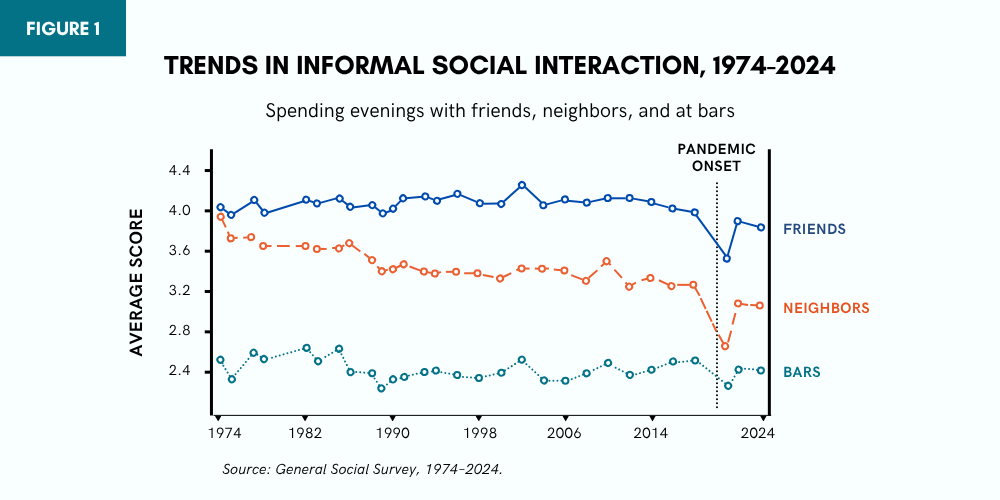
Figure 1. Trends in the frequency of spending evenings with friends, neighbors, and in public settings (bars), 1974–2024. All three measures show a sharp, simultaneous shift toward less frequent social interaction around the pandemic period (2020–2021), followed by a return toward pre-pandemic levels. The pattern suggests a temporary disruption rather than a lasting transformation in everyday social life.
The pandemic disrupted this rhythm in a clear and dramatic way. Around 2021, all three measures show a sharp decline. People spent less time with friends. Contact with neighbors dropped further. Visits to public places fell. Across different forms of interaction, social life retreated from its everyday routines.
But what happened next is just as important. In the years following the pandemic, these patterns began to recover. By 2022 and continuing into 2024, people reported spending more time with others again. Evenings with friends became more common. Interaction with neighbors stabilized. Public social activity returned, even if it remained less frequent than other forms of interaction. The overall pattern is one of disruption followed by return.
This tells us something important about social life. Patterns of everyday interaction tend to be stable and slow moving. Even when disrupted by major events, such changes are often temporary. Social life can contract sharply, as it did during the pandemic, but it does not necessarily stay that way. Instead, it tends to move back toward familiar routines.
This dynamic closely mirrors what I have found in my research on trust, which reflects generalized expectations about others’ honesty, fairness, and compliance with shared social norms. This form of social trust, like social interaction, changes slowly over time. It can shift in response to crises or major life events, but those changes are often short-lived. Over time, trust tends to return toward its long-term pattern. Both trust and everyday social interaction respond to disruption, yet they remain anchored in deeper social structures.
At the same time, the data point to a long-term trend that predates the pandemic. Even before 2020, people were gradually spending fewer evenings with friends, neighbors, and in public settings. This is not a sudden change, but a slow transformation unfolding over decades.
This pattern echoes the argument made long ago by the political scientist Robert Putnam about the decline of social capital and associational life. While Putnam focused on participation in organizations such as clubs, civic groups, and community activities, the evidence suggests that change extends beyond formal institutions into everyday social interaction. The decline is not only in joining, but also in simply spending time together.
Taken together, these patterns reveal a mix of disruption and continuity. Social life is organized through patterned routines, including when we see others, where we go, and how we spend our time. These routines can be interrupted, even suddenly, but they are often restored once conditions allow.
The pandemic undoubtedly changed many aspects of daily life, and some of those changes will persist. But when it comes to everyday social interaction, the evidence points as much to continuity as to change. The pandemic did not fundamentally redirect the course of social life. Instead, it briefly intensified a long-term pattern that was already underway. While social life was disrupted and retreated from everyday routines during the pandemic, it has largely returned, not to where it once was, but to the path it was already on.