

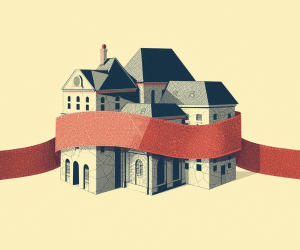
Across the United States, higher education is contracting. Since 2010, colleges and universities have lost more than two million students. The long-anticipated enrollment cliff, a steep decline in traditional college-aged students driven by demographic shifts, is now here. And it is reshaping the academic landscape.
At the same time, structural deficits are mounting. Public institutions and systems such as the one where I serve are tuition-dependent, under-resourced, and increasingly vulnerable. Unsustainable funding models where the majority of revenue comes from student tuition and fees, places an extraordinary cost burden on students. In response, universities across the country are taking drastic action, eliminating departments, laying off contingent faculty, and merging programs.
As a sociologist, I can turn to C. Wright Mills’s concept of the sociological imagination to understand the intersection of private troubles (biography) and public issues (social structure). This framework allows me to ask:
- Who benefits?
- Who bears the costs?
- How do institutions function under pressure?
This lens helps me lead with transparency and empathy, especially when making decisions under constrained circumstances.
As a provost, I understand that higher education must adapt to the environment. Attacks on academic freedom, increased pressure to prove the return on investment of a college degree, and the widespread misunderstanding of the values of the liberal arts are reshaping institutional priorities. And the liberal arts, in particular, are bearing the brunt of the cuts.
The liberal arts have been hit particularly hard. Lasell University in Massachusetts eliminated five majors, including English and history, to address its enrollment drops. St. Cloud State in Minnesota cut 42 degree programs and 50 minors, including music, as enrollment fell by more than 40 percent in a decade.
These challenges are compounded by ideological attacks on the social sciences. Early in 2024, Florida lawmakers removed introduction to sociology from the state’s general education curriculum—part of a broader effort to restrict what can be taught about race, gender, and systemic inequality. Federal research funding is being politicized. Grants distributed by the National Institutes of Health and the National Science Foundation have been abruptly canceled or frozen mid-cycle.
From a conflict theory perspective, these patterns are not surprising. Sociology is often among the first disciplines to face cuts—not because it is less valuable, but because it is less legible to policymakers and budget officers focused narrowly on workforce pipelines and revenue generation.
The Day I Announced the Deactivation of Sociology
It is in the environment of the Provost Office, I, a certified applied sociologist, made the hardest call of my professional life: recommending the deactivation of our undergraduate sociology program.
Deactivation does not mean immediate elimination. It means no new students will be admitted, and once the current cohort graduates, the program may sunset if the program is not revised and refreshed. Technically, the department still exists. This distinction provides little comfort.
And yet, as a provost, I must look at the broader institutional picture: declining enrollment numbers in the major, rising instructional costs, viability of the program, and a structural deficit that cannot be ignored. The need to remind sociology colleagues that institutions are not static was heartbreaking. Higher education must adapt to external and internal pressures to survive.
Today’s Students Are Changing—And So Should Our Models
Contrary to public perception, the typical student is no longer an eighteen-year-old living on campus. Increasingly, they are returning adults, parents, veterans, and part-time learners. Many work full time while pursuing degrees. And when students experience academic departments being merged and course offerings reduced, students and faculty interpret those changes in deeply personal ways: Is this degree worth it? Will I finish? Will I have a job?
Flexibility, affordability, and relevance are necessary. As a provost, I must balance institutional sustainability with student success. This means ensuring that academic programs are viable, relevant, and responsive in delivery. It means supporting the kind of knowledge that helps students make sense of the world. Considering how programs are delivered and how students are prioritized are a must during changing structures. Online instruction, alternative pathways, and micro-credentials are avenues that educators should consider.
Why We Need Sociologists in Decision-Making Roles
The irony is not lost on me: I helped deactivate the very program that trained me to critique systems such as the one I now help lead. This is why we need more sociologists in upper administration and leadership roles.
Sociologists understand that institutions are not neutral. They reflect historical inequalities, fiscal constraints, and shifting public narratives. As a provost, I approach budgets like I once approached field notes—attuned to patterns, contradictions, and structural blind spots. Sociological tools help me ask the right questions, even when there are no easy answers, and guide me as I strive to lead with integrity and transparency, even in times of scarcity.
Reinvention, Not Retreat—The Work Continues
I am not giving up on sociology. I am exploring how to embed sociological thinking into other programs and how to extend sociology’s public relevance through community engagement and applied research. This is a time of contradiction but also a time of reinvention. Academic leaders must adapt without abandoning our core values.
Sociology still shapes me: how I lead, the questions I ask, and the future I am tasked to build. This future includes students, especially those from underrepresented backgrounds, who can still find purpose, clarity, and justice in higher education.
Sociology does not eliminate hard decisions. It equips provosts with the ability to face them with humility, honesty, and care. Now more than ever, we need higher education leaders who understand systems, who can hold complexity without collapsing under it, and who are willing to imagine and work toward what comes next.