
On March 25, 2025, I had the privilege to sit around a table that had belonged to former Rep. John Lewis (D-GA) with six colleagues and advocate for the importance of social science research funding. The meeting was one of four with congressional staffers that I participated in during Social Science Advocacy Day in Washington, D.C. During the two-day event, I joined more than 70 other social and behavioral science researchers, faculty, students, and advocates from 17 different states who met with individuals from more than 60 congressional offices. While our specific request was to protect funding for social and behavioral science research, we also advocated for protecting the scientific workforce, the ability to conduct research free from political interference, and the standing of science in society.
Social Science Advocacy Day is organized by the Consortium of Social Science Associations (COSSA), a nonprofit advocacy organization working to promote and advance the social and behavioral sciences in federal policymaking. Founded in 1981 in response to budget cuts aimed at the social and behavioral sciences, COSSA’s goals are to: “champion robust, sustained funding for federally supported social and behavioral science research, and STEM research and education more broadly; support and strengthen the federal statistical and data enterprise; expand the use of social and behavioral science and data in policymaking; and advocate for diversity, equity, and inclusion in science.”
ASA was one of 10 disciplinary societies that founded COSSA, whose members now include professional associations, scientific societies, research centers and institutes, colleges and universities, and industry affiliates. Among its many contributions, COSSA was instrumental in the creation of the Social, Behavioral, and Economic (SBE) Directorate at the National Science Foundation (NSF) and the establishment of the Office of Behavioral and Social Science Research (OBSSR) at the National Institutes of Health (NIH). While this was the 11th year of Social Science Advocacy Day, for which ASA has been a longtime sponsor, the message was more urgent than ever this year.
A Spotlight on the Importance of the Social Sciences
Social Science Advocacy Day attendees were organized into state teams and provided with a wealth of materials and information to have productive meetings with congressional staffers, all of which were arranged in advance by COSSA. Day one included a preparation seminar that provided the advocacy day logistics and background information on key issues. An important part of the day was a panel discussion of the major challenges facing federal research agencies including NSF, NIH, agencies of the federal statistical system, the U.S. Department of Education and its Institute of Education Sciences, the National Endowment for the Humanities, the Institute of International Education, and the National Archives. Panelists discussed the disappearance of federal statistics, canceled contracts, and staff cuts, all of which impact the ability of social scientists to do their work, as well as the policies and programs that are informed by that work. The panel described social science research as infrastructure—a public good that also helps increase efficiency by informing policy and practice; as one panelist described, “You can’t manage what you don’t measure.” They also underscored that these resources and expertise cannot easily be replaced. We also met in our state teams to craft our message for our specific leaders on day one. All teams were provided with packets to give to each office during the meetings. These included specific appropriations requests for various agencies and information on federal funding for social science provided to the state.
Day two was the actual day of meetings, and I was part of the Maryland delegation. Our eleven-person team included faculty, staff, undergraduate and graduate students, and representatives from research and policy organizations working across a range of social and behavioral science issues, including crime and safety, health, language acquisition, autism, child welfare, and science policy. Together we met with staffers from both Maryland Senators’ offices. Because our team was large, we separated into two smaller groups, each meeting with two different Representatives’ offices. The meetings ranged from 10 to 30 minutes.
Messaging That Makes an Impact
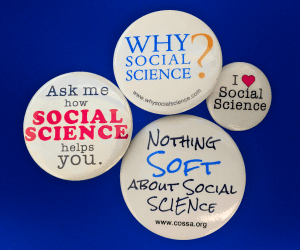 Our job as advocates was to make the message personal. Since Maryland is home to many agencies and organizations that both serve and receive funding for social science research (the National Institutes of Health, the National Archives, the Food and Drug Administration, the National Oceanic and Atmospheric Administration, and many colleges and universities), it wasn’t hard to share personal examples of how we are impacted at the state and local level. In addition to explaining how we rely on federal funding for our work, team members shared stories of neighbors who have lost their jobs, graduate students whose dissertations have been halted, undergraduates who are concerned about dwindling graduate school opportunities, and taxpayers who are being robbed of federally mandated data and resources that are no longer funded. Since our team was fortunate in that our congressional leaders are already taking a stance to protect social science funding, we approached our meetings in a spirit of collaboration and as the first, not last, point of contact. We wanted them to know that we and our colleagues can help inform and improve their work. ASA, for example, has subject matter experts in at least 53 areas and serves as a venue for advocacy and dissemination.
The staffers we met were very receptive to our message and to working together. They indicated that what they see most often are numbers on spreadsheets. What is most helpful is hearing personal stories of how people are impacted, the effects of funding, and the specific benefits of science to the public. They mentioned that having concrete examples of how both red and blue states have been impacted would help bipartisan efforts. Finally, having specific actionable items (for example, responding to the disappearance of federally mandated data) was useful.
Participating in Social Science Advocacy Day was an eye-opening and empowering experience that I would highly recommend to any sociologist or student of sociology. As constituents of the offices we visited, entry was relatively easy. COSSA provided all the necessary support materials to be successful, including follow-up instructions on submitting our funding requests to the congressional offices after our meetings. Because ASA is a member of COSSA, ASA members can benefit from their resources, such as email updates on developments impacting the social and behavioral sciences; analysis of pending legislation and agency policies; time-sensitive action alerts; and access to webinars and training. For more resources on engaging in social science advocacy, visit ASA’s Public Engagement initiatives.
Any opinions expressed in the articles in this publication are those of the author and not the American Sociological Association.