

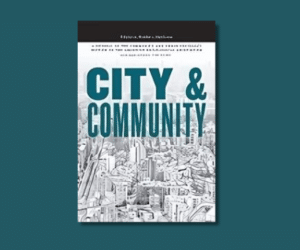
Editor’s Note: The ASA Council unanimously confirmed Ann Owens and Brian McCabe to become the co-editors of the City and Community journal for a three-year term beginning January 1, 2026. Patrick Sharkey’s following essay gives Footnotes readers a glimpse into Owens’ and McCabe’s vision for the journal.
On September 12, 2001, I woke up in my apartment in Washington, DC, and called the testing center where my GRE exam was scheduled for that morning. It was open, the test was on. I remember walking down eerily quiet streets, with tanks positioned at street corners, and a single airplane flying in circles above the city.
About six months later, when many still wondered whether our major cities would survive the terror threat, the first issue of City & Community—the journal of the American Sociological Association’s (ASA) Community and Urban Sociology Section(CUSS)—was published. It featured a lively set of essays about “schools” of urban sociology arising in L.A. and Chicago, including one from my soon-to-be advisor, Robert Sampson. I wish I could say I read that first issue when it was first sent out, but it would be another six months before I started graduate school. I knew nothing about the differences between the “Chicago School” and the “L.A. School.” Then I became a member of ASA, joined CUSS, and soon received one of the early issues of City & Community in my new department mailbox. The journal and I grew up together, in a sense.
In the years since, the very idea of the city has been threatened by the aftermath of that horrific attack on 9/11, by the housing collapse in 2007, and by a global pandemic in 2020. And as I write, there are again federal troops stationed in DC, roaming the streets of a city where violence has been falling sharply, seemingly without any clear sense of what they’re doing there. Through it all, cities have survived, arguably becoming more, not less, important to the economics, politics, and culture of the United States.
The journal, City & Community, has thrived as well. As it approaches its 25th year, two of the most creative, rigorous scholars in our field, Ann Owens and Brian McCabe, are preparing to lead the sixth editorial team. Owens is a professor of sociology at the University of California-Los Angeles. McCabe is a professor of sociology and director of graduate studies at Georgetown University.
Their vision for the journal is guided by five aims, and it is ambitious and exciting.

Engage urban sociologists. McCabe and Owens plan to re-engage with the ASA’s CUSS to ensure that the journal accurately reflects scholarship and directions in the subfield. They intend to survey CUSS members to identify the subfields, topic areas, and methodologies represented among urban sociologists—and in doing so, ensure that the direction of the journal reflects diversity of scholarship. They will use the survey to build a broad reviewer directory, which will ensure that review requests are aligned with CUSS members’ research expertise and interests. In addition to soliciting scholarship from CUSS members, the editorial team intends to invite submissions from other ASA Sections. This will offer an opportunity for a broader range of scholars working on community and urban scholarship to actively engage with conversations in the journal. Finally, they will continue to build professional development programs to help identify grow and support the next cohort(s) of urban sociologists.
Strengthen the editorial process. McCabe and Owens are committed to ensuring efficient and high-quality reviews of submissions. Like other editors, they will continue the practice of desk rejecting articles outside the journal’s scope or below its standards of rigor, ensuring fair and speedy responses when submissions are not appropriate for City & Community. The editors will work to minimize second revise and resubmit requests to ensure that the review process is efficient and constructive. They will clearly communicate author and reviewer guidelines and streamline the submission process by replacing cumbersome cover letters with a standardized submission form.
Ensure diverse representation in the editorial process. The incoming editorial team will uphold the journal’s commitment to diversity on the editorial board. One tool for doing so is to solicit open applications for the editorial board, in addition to comparing editorial board composition to that of ASA and the Section.
Expand publication formats. In addition to traditional research articles, McCabe and Owens intend to expand publication formats in City & Community. They will invite submissions for shorter research notes, commentaries, and data visualizations, among other formats. They will also publish invited symposia, including special issues to mark the journal’s 25th anniversary and anniversaries of landmark past scholarship. The editors intend to revamp the book review section to include shorter blurbs of more books, rather than accepting full reviews of a small subset of new books. Doing so will prioritize pages for new original research.
Build a public audience for urban sociology to deepen the impact of the journal. The editors will develop a communication strategy using social media, the ASA Journals podcast, and the CUSS newsletter to profile both new and “flashback” articles, especially during the journal’s 25th anniversary. They also intend to publish topic guides, which will be accessible, annotated bibliographies of previous City & Community articles on a particular topic (e.g., residential segregation, gentrification). Given their commitment to policy-oriented scholarship, the editors will also increase the journal’s focus on policy, possibly including commentary in symposia from practitioners and policymakers and developing strategies for direct communication to policy staffers.
Owens and McCabe are excellent choices to bring this vision to fruition. Owens completed her PhD in sociology and social policy at Harvard University and had a postdoctoral fellowship at the Stanford Center on Poverty & Inequality. Her research investigates the causes and consequences of social inequality, with a focus on neighborhoods, housing, education, and social policy, and with a particular focus on segregation. Owens has served on the editorial board of the ASA journal Sociology of Education and has coordinated two special issues of Housing Policy Debate on affordable housing policy. Owens has served in multiple ASA leadership roles, including on the Community and Urban Sociology Section Publications Committee, as the secretary/treasurer and chair of the student outreach committee of the Inequality, Poverty, and Mobility Section, and on multiple award committees for the Sociology of Education Section.
Owens is currently working in two principal areas. First, she is exploring how residential and school racial/ethnic and economic segregation correspond to one another and is identifying policy solutions to successfully reduce segregation in both contexts. Second, she is exploring links between housing and contextual inequalities, through (1) a project examining how the neighborhoods and schools surrounding LIHTC properties in California have changed since 1990 and (2) a project examining how new housing supply affects educational equity through school access.
McCabe completed his PhD in sociology at New York University, where he also worked at the Furman Center for Real Estate and Urban Policy. McCabe served on the editorial board of City & Community, 2018–2024 and currently serves on the editorial board of Housing Policy Debate. He is the author of No Place Like Home: Wealth, Community and the Politics of Homeownership (Oxford University Press 2016) and co-author with Jennifer Heerwig of Democracy Vouchers and the Promise of Fairer Elections in Seattle (Temple University Press 2024). He recently co-edited with Eva Rosen The Sociology of Housing (University of Chicago Press 2023) and with Peggy Bailey co-edited a special issue of Cityscape on the 50th anniversary of tenant-based rental assistance. McCabe also served as the deputy assistant secretary for policy development at the U.S. Department of Housing and Urban Development, 2022–2024.
McCabe is finishing a book manuscript, under contract with the University of Chicago Press, about scarcity in rental assistance programs. Drawing on fieldwork with public housing agencies nationwide, he shows how scarcity shapes nearly every aspect of the Housing Choice Voucher Program, from how agencies select participant households to the ways that selected households search for housing. The book brings a sociological perspective to the study of this important housing policy by identifying ways that policy and program design create and pattern inequality.
Ann Owens and Brian McCabe will bring their deep experience in the field of community and urban sociology to bear on their work as co-editors of City & Community—and we can’t wait to see the direction of the journal under their guidance.